
How the
science works.

Four principles that explain why Jadhu is built the way it is — and why it works across the full range of conditions, severity levels, and ages.

Built around how people actually learn.

01
Principle 01

Foundational skills must be built before they can be applied.

Real-world independence is not a skill you practise directly. It is the outcome of many underlying foundations — attention, communication, motor control, sensory regulation, cognition — all working together. A child who cannot sustain attention cannot benefit from a restaurant scenario. A child with severe sensory sensitivity cannot participate in a crowded environment until that sensitivity is addressed.

Jadhu builds foundations first, applies them second. Every session has both layers — a skill game targeting a foundational gap, and a scenario where that foundation is used. The two reinforce each other.

For clinicians

9-domain structure validated across BRIEF-2 (executive function), BOT-2 (motor), TVPS-4 (visual perception), CONNERS-3 (attention), PEERS (social-emotional), M-ABC-2 (gross motor/DCD), Vineland ABS (adaptive behaviour — ADL, communication, socialisation). Covers the full developmental taxonomy required for functional independence across ASD, ADHD, GDD, ID, CP, DCD, SPD, and learning disabilities.


02
Principle 02

Daily distributed practice builds skills that last.

Think of learning to ride a bike. You don't get better practising once a week. You get better practising a little, every day. This applies to every domain Jadhu covers — cognition, motor, communication, sensory regulation, social participation.

Two 30-minute sessions every day fills the gap that therapy alone cannot close — building habits, reinforcing foundations, and practising real situations continuously.

For clinicians

Distributed practice (spaced repetition) is one of the most replicated findings in learning science. Jadhu's 30-minute session protocol (×2 daily) is aligned to the FDA De Novo cleared EndeavorRx dosage (~25 min/day). Retrieval practice at increasing difficulty consolidates long-term procedural memory across motor, cognitive, and social-behavioural domains.

03
Principle 03

Skills must be practised in the real situation.

A child who practises managing noise in a therapy room has not learned to manage it at the school canteen. Generalisation failure is the most common reason therapy progress does not transfer to real life.

Jadhu practises the canteen inside the canteen. The metro inside the metro. The workplace inside the workplace.
For clinicians

Generalisation failure is documented across ASD, ADHD, DCD, ODD, ID, and CP literature. Jadhu's real-world scenario library covers community, educational, and vocational settings. D8 scenarios embed graded demands across multiple foundational domains simultaneously, generating multi-domain progress data from a single scenario — not just pass/fail completion data.

04
Principle 04

Anxiety blocks learning — even when it is invisible.

A learner who looks calm can be physiologically anxious. In that state, no new skill — foundational or applied — is being absorbed. Without measuring anxiety in real time, nobody knows when a session is landing and when it is not.

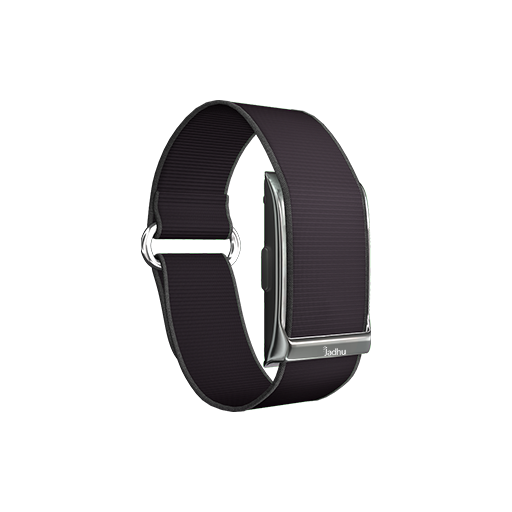
The Jadhu wristband measures anxiety continuously across both daily sessions. When it rises, the session responds — before it becomes a meltdown, a shutdown, or a refusal.

For clinicians

PPG-derived RMSSD — ESC recommended short-term HR metric. Relative change from personal session baseline. Anxiety threshold: HR drop >25% + HR increase >20 BPM. Valid across ASD, ADHD, CP, ID, and SPD profiles. SQI filtering excludes motion artefact during motor tasks. B2B clinical platform: sensory trigger settings (auditory/visual/social-crowd × low/medium/high) and Assist/Independent mode.

Three delivery modes one platform.

Jadhu delivers the same clinical content — 9 foundational domains, real-world scenario library, personalised prescription engine — across three hardware modes. The level of immersion differs. The science does not.

1

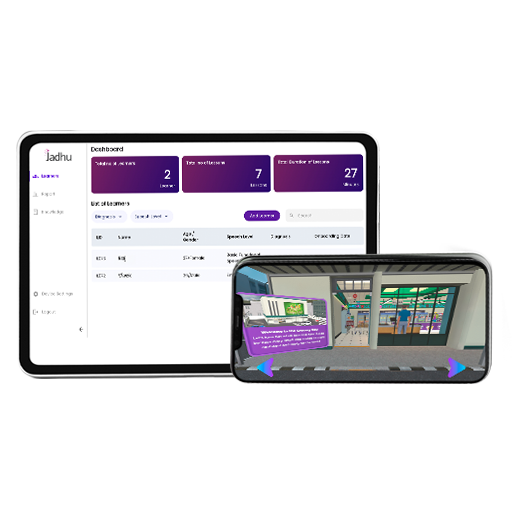
Mobile (smartphone or tablet)

What it delivers

Interactive 3D scenarios on screen. Tap/drag interaction. Full prescription engine. All 9 foundational domains. HR wristband integration. Parent WhatsApp report after each session.

Clinical use case

Daily home practice for all B2C subscribers. The primary mode for habit formation, foundational skill games, and assessment.

Available now
Android + iOS
2

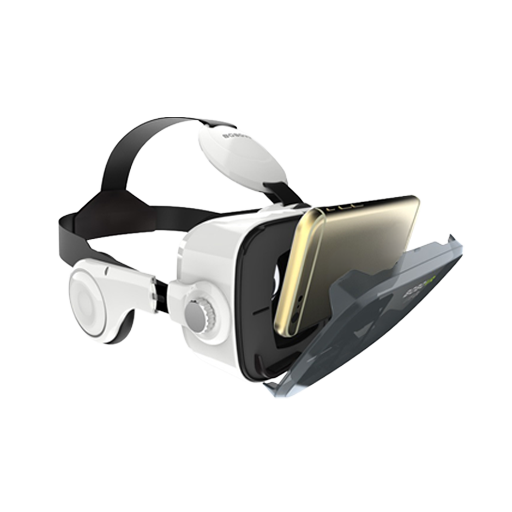
Jadhu Viewer (mobile Virtual Reality — coming soon)

What it delivers

Same content as mobile. Smartphone slides into a lightweight holder (similar to Google Cardboard). 360° immersive view — learner looks around the virtual environment. More context for generalisation.

Clinical use case

Higher-fidelity home practice for learners who benefit from stronger environmental immersion before real-world exposure. Particularly useful for ASD and sensory profiles.

Coming soon
~₹800–1,200 · ~3 months post-launch
3

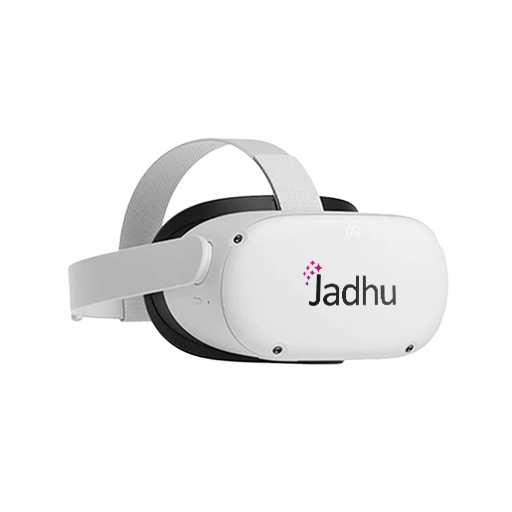
Meta Quest (clinical Virtual Reality)

What it delivers

Full room-scale VR. Spatial navigation. Complete sensory assessment protocol (visual, auditory, social-crowd × 3 intensity levels). Real-time HR overlay on therapist's tablet. Assist and Independent modes. White-label PDF session reports.

Clinical use case

Clinical deployment in therapy rooms and hospitals. The highest-fidelity generalisation environment — learner physically moves through the virtual situation. Used at PSG, SRM, Sri Ramachandra, Swabhimaan Trust.

Available now
~₹32,000 hardware · B2B deployment
For clinicians

The prescription engine, assessment data, and content library are shared across all three modes. A learner assessed on mobile at home can continue in clinical VR at their therapy centre with full session history continuity. The clinical VR platform (Meta Quest) adds the complete sensory assessment protocol and Assist Mode — not available on mobile or Jadhu Viewer. These are B2B-only features.

Evidence

Peer-reviewed.
Not promises.

Pilot study
· Swabhimaan Trust, Chennai
· 2024
· Full data available for clinical partners and researchers
· research@jadhuhealth.com

Pilot studyMeasured outcomes
0172%

Real-world improvement

0240%

Anxiety reduction (HR)

034.7/5

Parent satisfaction

046 Weeks

To measurable improvement

Clinical framework alignment

Recognised measures, mapped to meaningful outcomes.

FrameworkJadhu alignment
BRIEF-2Executive function — inhibition, working memory, flexibility
BOT-2Motor proficiency — fine and gross motor
CONNERS-3Attention and ADHD profile
TVPS-4Visual perceptual skills
PEERSSocial and emotional skills
M-ABC-2Gross motor and DCD profile
Vineland ABSAdaptive behaviour — ADL, communication, socialisation, motor
RMSSD / HRAnxiety monitoring — autonomic nervous system regulation
Clinical researchDownload the clinical evidence pack: research@jadhuhealth.com